Practice area · 06/08
Fraud risk.
Assessments, control design, and forensic support when a case requires it. The point is to find the fraud before your examiner does.
Assessments, control design, and forensic support when a case requires it. The point is to find the fraud before your examiner does.
Most institutions discover fraud risk after a loss. We come in before.
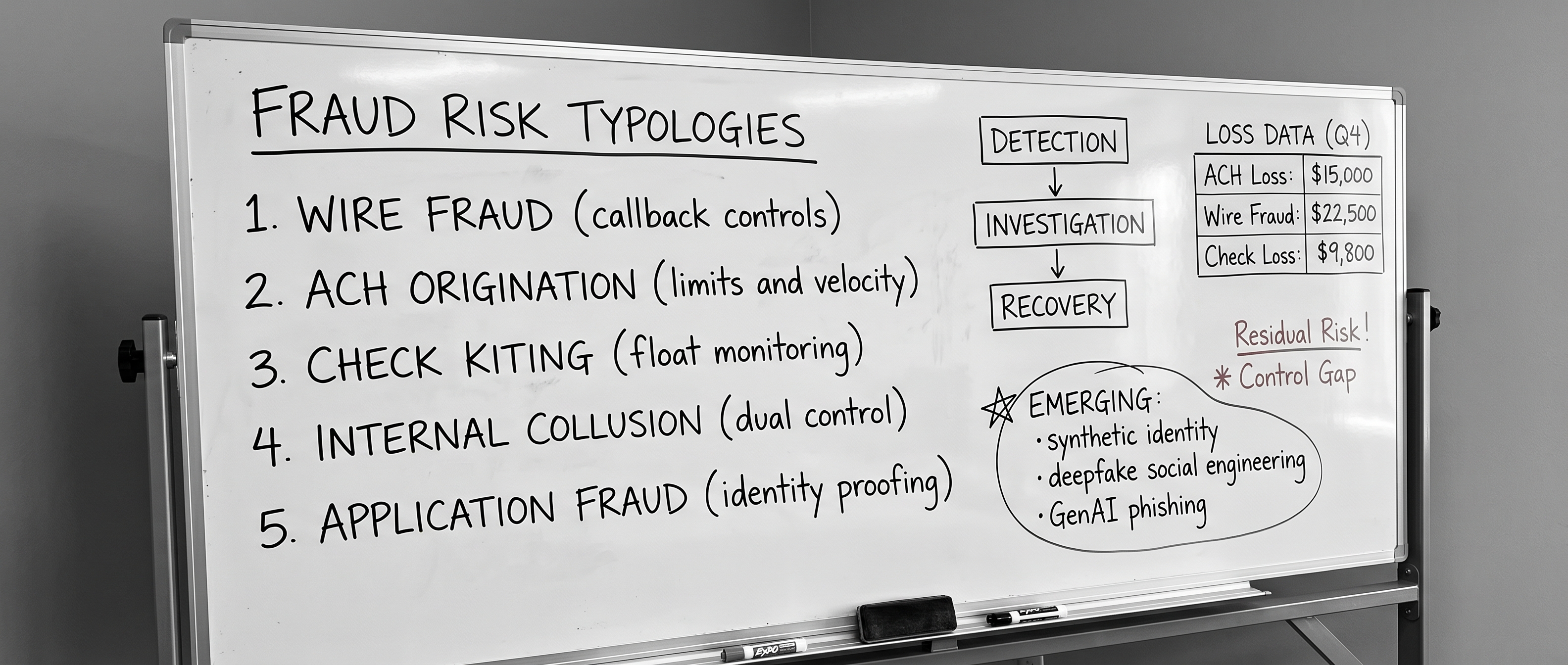
The vast majority of financial-institution fraud loss comes from a small number of typologies — wire fraud, ACH origination, check kiting, internal collusion, application fraud, account takeover — and a smaller number of control failures (segregation of duties, dual-control overrides, alert disposition, exception handling). Our practice helps institutions assess where their exposure actually is, design the controls that would catch it, and respond when something has already happened.
We engage in three modes: enterprise fraud risk assessments (typically annual, sometimes tied to regulatory expectations); fraud control design (process redesign, system configuration, alert routing); and forensic support when a specific case is open. The forensic work is partner-led; we do not turn it over to a junior team.
Fraud risk is also where AI most clearly changes the conversation. Synthetic identities, deepfake-enabled social engineering, machine-generated phishing — the typologies that mattered in 2020 are not the ones that will matter in 2027.
Typology inventory, loss data analysis, control mapping, residual risk rating.
Process redesign, system configuration, alert routing, exception handling.
Case-specific investigation support, evidence preservation, root-cause analysis.
Emerging-typology assessment, model-based detection, identity verification posture review.
Segregation of duties, privileged-action monitoring, dual-control governance.
Loss event reporting, board-level fraud reporting, regulator communication.
Three-year loss data analyzed, typologies catalogued against industry data.
Each typology mapped to existing controls; gaps identified and rated.
Inherent risk × control effectiveness = residual; calibrated to the committee's appetite.
Control remediation plan, sequencing, owners, dates.

Quantitative Risk · Analytics · MIT
Edgar has built and validated the detection models behind fraud and AML programs across banking and fintech for twenty-five years, and brings quantitative rigor to forensic support engagements across the Americas.
We do not take engagements as an expert witness in litigation against current clients, nor do we represent counterparties in fraud disputes where we have prior knowledge of the institution.